A common pitch in AI content marketing is a number: thirty articles a month for $99. The number is the product. It’s the headline on the pricing page, the figure in the ad, the top row of every comparison table. We studied that offer closely while building MergePress and decided to sell against it. We ship three posts a month, sometimes four, each one you read before it publishes. This post is the argument for why the smaller number is the better deal, and where that argument stops being true, because it does.
What “thirty for $99” actually buys
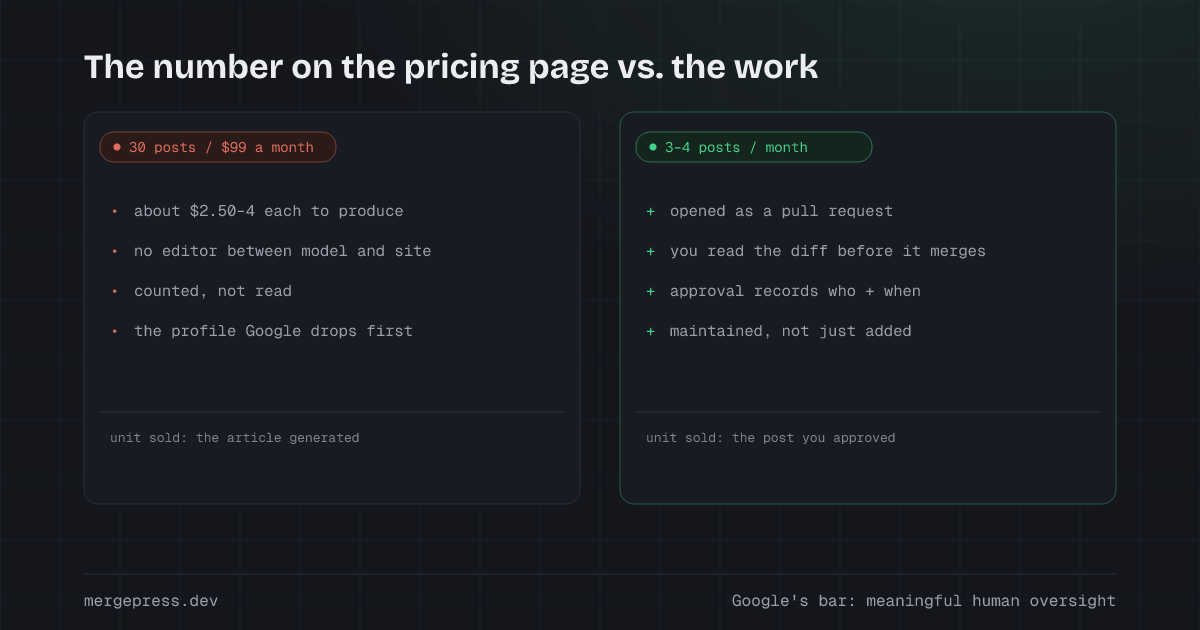
Start with the arithmetic, since it’s the part the headline leaves out. At $99 for thirty articles, each post costs somewhere between $2.50 and $4 to produce, that’s roughly the effective per-article economics across the AI-writing category. Nothing at that price includes a person reading the post before it lands on your domain. It can’t. A human editor at even a junior rate would erase the margin inside the first two posts. So what the number buys is volume, unreviewed: thirty drafts generated, published, and counted, with no editorial pass between the model and your live site.
Compare that with what a reviewed post costs elsewhere. Mid-tier freelance writers run $150 to $400 a post; agencies charge roughly $1,000 to $2,500 a month. A per-approved-post service priced at $99 a month for three or four posts works out to about $25 to $33 per post, an order of magnitude more than the autoblog tools charge per article, and several times less than a credible freelancer. The gap in price is a gap in what changes hands. The autoblog sells you thirty things nobody read; the reviewed model sells you three things you did.
Google moved the goalposts in 2024
Volume used to be a defensible strategy on its own: more pages, more chances to rank. That changed with Google’s spam-policy update in March 2024. The policy now targets what our research summarizes as content “mass-produced without meaningful human oversight.” The load-bearing phrase is human oversight, not word count, not whether a machine wrote it. Google has been clear that AI-assisted content is fine. Content produced at scale with no one meaningfully involved is the target.
The consequence tends to show up before any penalty does, at indexing. A page Google declines to index cannot rank for anything; it’s simply absent. One large analysis of about 1.7 million pages found that 88% of non-indexation was quality-related rather than a technical or submission problem. And when Google ran a broad deindexing pass in May 2025, weak sites reportedly lost somewhere between 15% and 75% of their indexed pages. Read those two figures together and a pattern appears: a flood of thin, unreviewed posts is exactly the profile most exposed to being quietly dropped. You can pay for thirty posts and end up with Google keeping three.
That reframes the whole “more is better” instinct. If a large share of low-oversight pages never make it into the index, then the headline count and the count that does anything for you are two different numbers, and the price you paid was for the first one.
The per-approved-post model is a different product
The volume tool’s unit is the article generated. Ours is the post you approved. That isn’t a marketing reframe; it changes what the service can and can’t do.
If nothing publishes until you approve it, there’s no way to pad a slow month with filler to hit a quota; there’s no quota except the posts you sign off on. It also inverts the incentive. A volume tool is rewarded for producing more, good or not; a per-approved-post service only gets paid when you decide a specific post is worth publishing. The thing the customer buys and the thing the provider optimizes for finally point in the same direction.
It’s a slower business to run, and it caps our own upside; we can’t grow a client by shipping more, only by shipping better. We think that constraint is a feature. It’s also the model that survives contact with Google’s stated policy, because the policy is essentially asking for the exact thing this model is built around: a person, meaningfully involved, before publication.
The trade the customer makes is worth naming plainly. You give up the comfort of a big number on the invoice: thirty feels like more than three, in exchange for posts that are more likely to be indexed, more likely to be read, and attached to a decision you actually made. For a small site that mostly needs a handful of pages that rank and convert, that’s the better trade nearly every time. For a site whose growth genuinely depends on page count, it isn’t, and we say as much below.
Approval is an audit trail, not just a checkbox
We wrote a whole post about the security side of the approval step, why a content tool shouldn’t hold the keys to your site, but approval matters for content quality too, and directly for the Google problem above.
Every MergePress post arrives as a pull request. When you approve it, the merge records who approved, when, and against exactly which version of the text. That record lives in your repository’s history, on infrastructure you own, not in a vendor dashboard that disappears when you cancel. If Google’s bar is “meaningful human oversight,” a repository where every published post carries a timestamped human approval is about the strongest evidence of oversight you can hold. It’s an audit trail rather than an assurance, the difference between showing a record and making a promise.
Thirty auto-published posts produce the opposite record: a burst of near-simultaneous commits from a bot, with no human decision attached to any of them. If a policy reviewer or a future you ever asks “who decided this should be on the site,” the honest answer for the autoblog is no one.
Often the best post is one you already published
There’s a second reason to be skeptical of the volume model: writing new posts is frequently not the highest-return work available.
The most-cited example is HubSpot’s “historical optimization” program, updating and re-publishing old posts instead of only writing new ones. The company credited it with a 106% increase in organic views, and reported that 76% of its views and 92% of its leads came from old posts rather than new ones. Treat those figures as directional, not proof: it’s one company describing its own results, not a controlled trial, and it ran on a large, already-established blog. But the underlying logic travels. An older post that already ranks and already has links is a known quantity; a brand-new post is a bet. Refreshing the known quantity often returns more than adding to the pile.
There’s a weaker, related signal on the AI-answer side: pages that AI engines cite tend to run somewhat fresher than average. It’s a real correlation but a modest one, and the broader evidence on “optimizing for AI” is genuinely mixed, a peer-reviewed replication of the popular generative-engine tactics found most of them ineffective, with ordinary search optimization several times more useful than the best trick. So we treat freshness as a reason to maintain good posts, not as a lever to game. A tool committed to thirty new posts a month has no attention left for maintenance; it’s busy generating the next thirty.
When volume is actually the right call
An honest argument names its own limits, so here are the conditions under which the thesis of this post fails.
- Three only wins if the three are good. The low number does nothing on its own. Fewer posts makes real review possible; it does not make it happen. Approve without reading and three unread posts are just a smaller flood with a nicer story attached. The mitigation is a smaller pile, not a magic one.
- Some sites genuinely need volume. A programmatic site generating location or comparison pages, a large product catalog, a working newsroom, there are real cases where producing many pages is the correct strategy, done deliberately, with systems and people behind it. If that’s your site, a tool built for volume may be the right tool, and we’d tell you so.
- The review has to be real to count as oversight. The Google argument here rests entirely on the oversight being meaningful. A rubber-stamp approval manufactures the audit trail without the substance behind it, which protects no one, and if it becomes a habit, misleads mainly yourself.
Stated narrowly, and we think correctly for most small and mid-size sites: a few posts you actually read and approved will beat thirty you didn’t, on quality, on the odds of staying indexed, and on the paper trail that’s starting to matter. It is not a claim that fewer is always better, everywhere, for everyone.
Three, on purpose
We landed on three to four posts a month because it’s an amount a person can actually read in the time a busy owner has, because it’s enough to build topical depth over a year without burying it, and because our model makes any post that isn’t worth reading pointless to produce in the first place.
If you want to watch the loop (propose, approve, ship, verify), it’s on the home page, and more of these notes are on the blog. The pricing pages that lead with a big number are selling the number. We’d rather sell you the three posts you’ll stand behind.